
How Much Protein Do I Need?
Protein Calculator
How we calculate: your weight in kilograms multiplied by a factor based on activity (1.0 to 1.8 g/kg), plus a small goal adjustment and a small increase for adults 65 and older. The target is the same for men and women at the same weight and activity level. This is an estimate, not medical advice.
You open a nutrition article and read that you need 100 grams of protein a day. Then another one says 60 grams is plenty. A fitness friend tells you 200 grams is the real number. Three sources, three answers, and none of them explain how they got there. The truth is simpler than the noise suggests. Your protein target is not a fixed number. It follows your body weight, your activity, your age, and your goal. A how much protein do i need calculator gives you that number in seconds, and this page explains how it works, so you can stop guessing and start eating toward a target that fits your life. The calculator above gives you a personal target right away, and the rest of the page walks through the formula, the tables for every situation, and how to hit your number every day.
The Short Answer
For most healthy adults, the practical range is 1.0 to 1.6 grams of protein per kilogram of body weight per day. That range covers daily repair, regular exercise, and a normal active life. The official minimum is lower. The recommended dietary allowance is 0.8 grams per kilogram, which is the floor that prevents deficiency, not the amount that helps you feel and perform your best.
A 70 kilogram person lands near 70 to 112 grams a day inside that range. A 90 kilogram person lands near 90 to 144 grams. Your exact spot depends on how active you are and what you are trying to achieve. Sedentary days sit near the bottom. Training days sit near the top. The sections below break it down by activity, goal, and age, so you can pin your number down.
How to Calculate Your Number
The formula has one step. Multiply your weight in kilograms by a protein factor. That factor is the grams of protein you need for each kilogram you weigh, and you pick it from your activity level and goal. Daily protein in grams equals weight in kilograms times the factor.
Here is the formula in action. Take a 70 kilogram person who walks daily and lifts twice a week. A factor of 1.4 fits that life. Multiply 70 by 1.4 and you get 98 grams per day. The same person on a quiet week with no training could use 1.2 and land at 84 grams. If you weigh yourself in pounds, divide by 2.2 first. A 165 pound person weighs 75 kilograms, and 75 times 1.4 gives 105 grams.
If your body weight is very high, total weight can push the number too far up. Fat tissue needs little protein to maintain, so many dietitians suggest using a goal weight or a lean mass estimate instead. Our protein calculator by weight walks through that choice in detail, and it shows your target at every level side by side.
How the How Much Protein Do I Need Calculator Works
The how much protein do i need calculator above runs the same formula for you. Enter your weight, pick your activity level and goal, and it shows your daily range in grams. You can enter kilograms or pounds, and the tool converts the number for you. It also shows a per meal split, so you can see how the total breaks down across breakfast, lunch, dinner, and a snack.
The result is an estimate built on published protein guidance, not a prescription. It does not know your medical history or your lab results. If you have kidney disease or another health condition, ask your doctor before raising your protein intake. For healthy adults, the number it gives is a strong starting point, and you can adjust it after a few weeks of real results.
Protein Needs by Activity Level
Activity moves your factor more than anything else. A desk worker and a lifter of the same weight need very different amounts, because training breaks muscle down and protein rebuilds it. The table below shows the factor for each activity level, with the daily total for a 70 kilogram person.
| Activity level | Factor (g/kg) | Daily total at 70 kg |
|---|---|---|
| Sedentary | 1.0 to 1.2 | 70 to 84 g |
| Lightly active | 1.2 to 1.4 | 84 to 98 g |
| Moderately active | 1.4 to 1.6 | 98 to 112 g |
| Very active | 1.6 to 1.8 | 112 to 126 g |
| Athlete or heavy training | 1.6 to 2.2 | 112 to 154 g |
Be honest about your activity. Many people pick a level above their real life, which pushes the target higher than they can eat. Three easy walks a week is lightly active. Five hard training sessions is very active. Enter your weight in the how much protein do i need calculator above and it shows your range at once. If you train for a sport, our athlete protein calculator breaks the number down by sport type and training volume.
Protein Needs by Goal
Your goal picks your factor almost as much as activity does. The same person needs a different target when they maintain weight, build muscle, or lose fat. The how much protein do i need calculator above adjusts the factor for each goal, so start there and read on for the detail.
Maintain Your Weight
If you are happy with your weight and want to keep it, 1.0 to 1.4 grams per kilogram covers most adults. Active people sit at the top of that range. A 70 kilogram person who walks daily and trains twice a week lands near 84 to 98 grams. You do not need an athlete’s number to maintain. You need enough to cover daily repair and your training, and no more.
Build Muscle
Muscle growth asks the most from your diet after fat loss. Training damages muscle fibers, and protein supplies the amino acids that rebuild them. Research on resistance trained people consistently lands between 1.6 and 2.2 grams per kilogram for maximizing muscle growth. A 70 kilogram lifter targets 112 to 154 grams a day. Beginners can start at the low end, since new lifters grow well on moderate protein. Advanced lifters chasing every last bit of progress tend to sit near the top. More than 2.2 rarely adds anything except cost. Our protein calculator for muscle gain is built around exactly this range.
Lose Fat
Losing fat calls for the highest protein of any goal. When calories drop, the body looks for energy anywhere it can find it, including muscle. A higher protein target tells it to burn fat instead. The range for fat loss runs 1.8 to 2.4 grams per kilogram. A 70 kilogram person dieting at 2.0 grams per kilogram targets 140 grams a day. If you take a GLP-1 medicine, our GLP-1 protein calculator sets a target for that situation, and our Wegovy protein calculator covers the same ground for that medicine. For dieters who do not take these medicines, our protein calculator for weight loss is built around this range.
Protein Needs by Age
Age changes how your body uses protein. Young bodies are still growing, and older bodies become less efficient at turning protein into muscle. The factor moves with your stage of life.
Teenagers
Teenagers who are still growing need relatively more protein per kilogram than adults, roughly 1.0 to 1.5 grams per kilogram depending on activity. A 60 kilogram active teenager lands near 60 to 90 grams a day. Growth, school sport, and training all raise the number. Our teenager protein calculator goes deeper for this age group.
Adults
Adults between 19 and 50 use the standard ranges on this page. Sedentary adults can start near 1.0 grams per kilogram, and active adults do better at 1.2 to 1.6. Women have similar ranges to men at the same weight and activity level, since the official minimum is 0.8 grams per kilogram for both. Our protein calculator for women covers the details for women, including pregnancy and breastfeeding, which raise needs noticeably.
Over 50 and Seniors
After 50, muscle becomes harder to maintain, and the body uses protein less efficiently. Older adults should add about 0.2 grams per kilogram to their factor, and aim for 1.2 to 1.6 grams per kilogram even when sedentary. A 70 kilogram person over 65 lands near 84 to 112 grams a day. Spreading protein across meals matters more with age too, since older muscles respond better to a steady supply than to one large serving. If you have kidney disease or another health condition, ask your doctor before raising your intake.
Protein Per Meal: How to Split Your Target
A daily number only works if you can eat it. Spreading protein across the day works better than loading it into one meal. Your body uses protein best in regular servings, so aim for 20 to 40 grams at each main meal, plus a smaller snack if your target is high. The how much protein do i need calculator above shows your per meal split too, so you can plan each plate.
| Meals per day | Protein per meal (for a 120 g day) |
|---|---|
| 3 meals | about 40 g |
| 4 meals | about 30 g |
| 5 small meals | about 24 g |
Four meals is the easiest pattern for most people. Three large meals can feel like too much food at once, and five small meals suit people with a small appetite. Pick the pattern that fits your day, then keep the per meal number steady. If you want a plain daily number first, our daily protein intake calculator sets one in seconds.
A Sample Day (About 100 g)
Here is what a day near 100 grams can look like. The numbers are approximate, and you can swap any item for a food you like better.
| Meal | Example | Protein (approx.) |
|---|---|---|
| Breakfast | Greek yogurt with berries and a boiled egg | 23 g |
| Lunch | Grilled chicken salad with quinoa | 35 g |
| Snack | Cottage cheese with fruit | 15 g |
| Dinner | Baked salmon with vegetables and rice | 27 g |
| Total | about 100 g |
Build your own version with the meal protein calculator. It adds up a full plate for you, so you can see the total before you eat. If the how much protein do i need calculator gave you a higher target, add a second snack or a larger portion at lunch.
Best Protein Foods
The best protein foods give you the most grams for the least effort. Animal foods are the densest, but beans, lentils, and tofu cover the number well too. These are the numbers our protein food calculator uses, so you can check any portion there.
- Chicken breast, cooked. About 31 grams per 100 grams, lean and easy to add to any meal.
- Salmon. About 25 grams per 100 grams, plus healthy fats.
- Tuna, canned. About 26 grams per 100 grams, ready straight from the tin.
- Greek yogurt, plain. About 17 grams per 170 gram serving, no cooking needed.
- Cottage cheese. About 12 grams per 100 grams, soft and quick to serve.
- Eggs. About 6 grams each, and they cook in minutes.
- Lentils, cooked. About 18 grams per cup, filling and cheap.
- Tofu. About 8 grams per 100 grams, good in soups and stir fries.
- Milk. About 8 grams per cup, an easy way to add protein without another meal.
- Protein shake. About 24 grams per scoop, useful when solid food feels like too much.
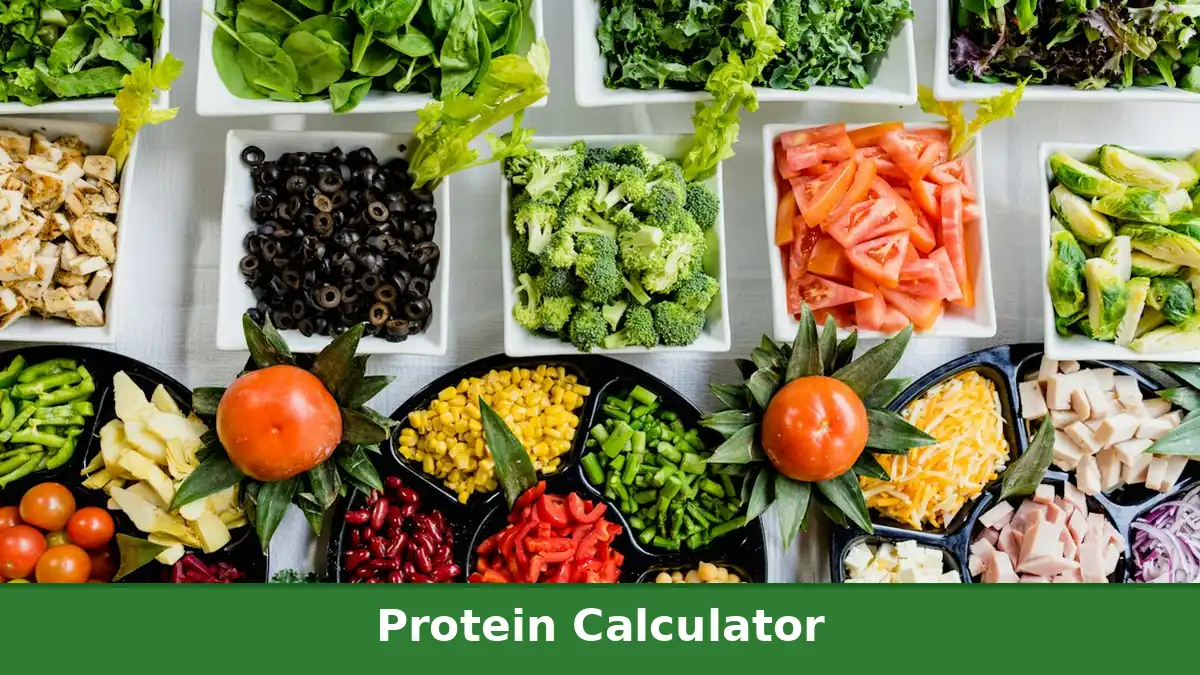
Keep two or three of these ready at all times. When you know the grams for your usual foods, hitting your target stops feeling like a chore and starts feeling like a habit.
Common Mistakes to Avoid
Most people miss their target for simple reasons, not because the math is hard. Watch for these.
- Eating far too little. Many people eat well below the 0.8 minimum without knowing it, then wonder why they feel tired or lose strength.
- Loading it all into one meal. A 60 gram dinner does not make up for a protein free breakfast and lunch. Spread it out.
- Ignoring activity. The same factor does not fit a desk week and a training week. Recalculate when your routine changes.
- Using total body weight when body fat is high. Fat tissue needs little protein, so goal weight or lean mass gives a better target.
- Chasing the highest number online. More is not automatically better, and a target you cannot eat helps no one.
- Forgetting to recalculate. Your target falls as your weight falls, so rerun the calculator every 5 to 10 kilograms.
Sources
Our ranges follow published sports nutrition guidance. The main sources are the International Society of Sports Nutrition position stand on protein and exercise (2017), the National Institutes of Health Office of Dietary Supplements protein fact sheet, and the USDA FoodData Central database for food protein values.
- International Society of Sports Nutrition position stand on protein and exercise, 2017
- National Institutes of Health Office of Dietary Supplements protein fact sheet
- USDA FoodData Central
Frequently Asked Questions
How much protein do I need per day?
Most healthy adults need 1.0 to 1.6 grams per kilogram of body weight per day. A 70 kilogram person lands near 70 to 112 grams. The official minimum is 0.8 grams per kilogram, but that is a floor to avoid deficiency, not an optimal target. Run the how much protein do i need calculator above with your weight and activity for a personal range.
How do I calculate how much protein I need?
Multiply your weight in kilograms by a protein factor. Pick 1.0 to 1.2 if you are sedentary, 1.2 to 1.6 if you are active, and up to 2.2 if you train hard or build muscle. A 70 kilogram person at 1.4 grams per kilogram needs about 98 grams a day. Divide pounds by 2.2 first if your scale speaks pounds.
How much protein do I need to build muscle?
Research points to 1.6 to 2.2 grams per kilogram for building muscle. A 70 kilogram lifter targets 112 to 154 grams per day, and an 80 kilogram lifter targets 128 to 176 grams. Beginners can start at the low end. Going above 2.2 rarely adds measurable benefit, so there is little reason to push past it.
How much protein do I need to lose weight?
While cutting calories, 1.8 to 2.4 grams per kilogram helps preserve muscle, which keeps your metabolism steadier and your results looking better. A 70 kilogram dieter at 2.0 grams per kilogram aims for 140 grams a day. Protein becomes more important in a deficit, not less, so protect the target first.
How much protein should I eat at each meal?
Aim for 20 to 40 grams at each meal. Three meals of about 40 grams suit a 120 gram day, and four meals of about 30 grams work just as well. Breakfast matters most, since a protein free morning leaves lunch and dinner to carry the whole day. The daily total matters more than the split.
Do I need more protein as I get older?
Yes, in most cases. After 50, the body uses protein less efficiently, so older adults should add about 0.2 grams per kilogram and aim for 1.2 to 1.6 grams per kilogram even when sedentary. Spreading protein across meals matters more with age, since older muscles respond better to a steady supply.
What happens if I eat too little protein?
You may feel tired, lose strength, and recover slowly from training. Over time, low protein can cost you muscle, which slows your metabolism and makes everyday tasks feel harder. The official minimum is 0.8 grams per kilogram, and most adults do better above it. If you feel run down, check your intake for a week.
Is 100 grams of protein a day enough?
For many adults it is a solid target, but it depends on your weight. A 70 kilogram person at 1.4 grams per kilogram needs about 98 grams, so 100 grams fits well. A 100 kilogram person at the same factor needs 140 grams, so 100 grams falls short. Your weight sets the number, not a round figure.
Final Thoughts
Your protein number is personal, and now you can work it out yourself. Start with your weight, pick a factor that matches your real activity and goal, and multiply. Most adults land between 1.0 and 1.6 grams per kilogram, lifters between 1.6 and 2.2, and dieters between 1.8 and 2.4. Use the how much protein do i need calculator above to set your number, write it down, and build your next three meals around it. Split the total across your meals, keep two or three protein foods ready, and rerun your number every few kilograms as your weight changes. Small habits, repeated daily, do more than any perfect number on a page. What is one high protein food you can add to your breakfast tomorrow?
Plan your meals with the Protein Food Calculator and the Meal Protein Calculator, or check your number with our protein calculator by weight.